 Skip to content
Imagine this: a new fashion brand spends months perfecting a collection. The draws are faultless, the fabrics are sourced, and the fervor is tall. However, when the first generation tests arrive, the garments show up to be nothing like what the creator envisioned—sizes are conflicting, sewing is inaccurate, and the colorways are totally off.
This is a common scenario when a tech pack is missing. In today’s fast-moving design industry, depending on verbal explanations or dubious drawings isn’t sufficient. Miscommunication can lead to wasted cash, lost time, and a damaged brand reputation.
A clothing tech pack solves this issue. It’s the extreme blueprint that bridges the gap between inventiveness and fabrication. By enumerating everything—from measurements and fabrics to trims, prints, and packaging—it ensures that everyone involved in the production is on the same page.
At techpack.uk, we help brands turn plan concepts into clear, proficient Fashion Tech Packs that producers can take after with accuracy. Whether you’re propelling an unused activewear line or scaling a design brand, a tech pack is the contrast between costly mistakes and consistent production.
What Is a Clothing Tech Pack?
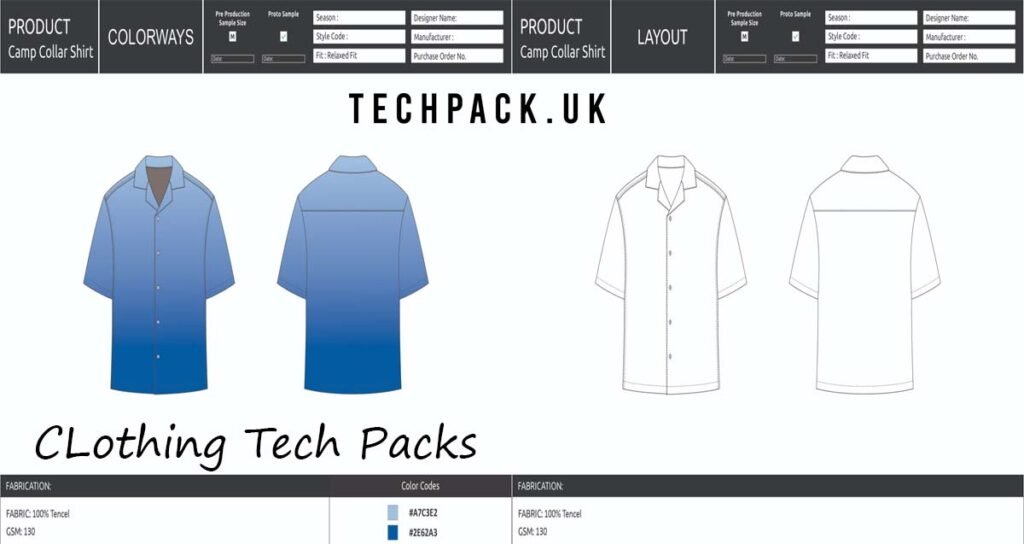
A clothing tech pack (short for technical package) is a detailed report that communicates all the fundamental data about a garment design to producers. Think of it as the diagram of your fashion design—covering estimations, textures, trims, colorways, sewing, and development details.
Without it, producers are left speculating, which frequently leads to delays, destitute fits, and costly errors. With it, brands pick up control and clarity, guaranteeing that their garments are made precisely as envisioned.
A solid tech pack ordinarily includes
- Technical outlines & CAD drawings
- Measurement charts (spec sheets)
- Fabric and trim detail
- Colorways and print placements
- Construction guidelines
- Label & bundling requirement
- Revision history for version control
Why Clothing Tech Packs Are Essential
A clothing tech pack is more than fair, a design sheet—it’s a communication apparatus, quality affirmation direct, and cost-saving procedure rolled into one.
Here’s why they matter:
Protecting Your Brand Reputation
Poorly executed garments harm the validity quickly. Customers take note if clothing doesn’t fit well, fades after one wash, or has sewing surrenders. A detailed tech pack dispenses with miscommunication with producers and guarantees a steady, proficient finish.
Reducing Costs & Preventing Waste
Every botch in generation costs money—whether it’s squandered fabric, incorrect measuring, or revamped tests. Tech packs diminish blunders by giving clear, enlightening, and forthright information, making your generation more sustainable and cost-effective.
Streamlining Communication
Manufacturers, providers, and generation teams frequently work across nations and dialects. A clothing tech pack is a widespread term for fashion—it leaves no room for misunderstanding.
Scaling Your Business
Whether you’re creating 50 pieces or 50,000, a tech pack standardizes your forms. This implies you can certainly scale up generation without losing quality or consistency.
Key Components of a Clothing Tech Pack

At techpack.uk, we break down tech packs into several essential parts:
- Technical Sketches & Drawings
Flat sketches (front, back, side views) or CAD plans that show each garment detail—from crease lines to button placement.
- Measurement Specifications (Spec Sheet)
The size chart that diagrams all key garment estimations: chest, midriff, sleeve length, inseam, collar width, and more. Each estimate (XS, S, M, L, XL) is evaluated accordingly.
- Fabric & Trim Details
Precise data on fabric composition, weight, surface, and source. Moreover, it incorporates trims such as zippers, buttons, snaps, and versatile bands.
- Colorways & Print Placement
Clear details on Pantone codes, color information, and arrangement for prints, weaving, or logos.
- Construction Guidelines
Instructions for sewing sorts, crease wraps up, trimming, support, and garment durability.
- Labeling & Packaging Requirements
Everything from care names to hang labels, barcodes, polybags, and box specifications.
- Revision History
Tracks changes in design, fit, or textures to guarantee producers continuously work on the most recent version.
Step-by-Step Guide to Creating a Clothing Tech Pack
Making a Clothing Tech Pack may feel overwhelming at first, but it’s the spine of smooth communication between architects, producers, and suppliers. A well-structured tech pack decreases costly botches, improves proficiency, and guarantees that your garments are delivered precisely as intended. Here’s a detailed step-by-step process:
Step 1: Start with the Design Concept
Your design is the foundation. Start by transforming starting outlines, mood boards, or fashion motivations into clear, level, specialized drawings (front, back, and side views). These ought to be computerized outlines, regularly made utilizing software like Adobe Artist or CLO 3D, rather than rough hand sketches.
👉 Example: If designing a hoodie, appear front see (with kangaroo take), back see (with hood crease), and side see (appearing sleeve details).
Pro tip: Add explanations for special design features—such as curiously large fit, trimmed fix, or flexible drawstrings.
Step 2: Define Measurements (Specs & Grading)
Precise measurements are vital. Work with a design producer to make an estimation chart for each garment estimate. Incorporate chest, midsection, length, sleeve, and other basic points of measurement (POMs).
👉 Example:
- Size M: Chest 40”, Length 28”, Sleeve 25”
- Size L: Chest 42”, Length 29”, Sleeve 26”
Include estimate evaluating rules so producers know how to scale the garment over XS–XXL.
Pro tip: Include resiliences (acceptable +/- variation), e.g., “Chest: 40” ± 0.5.”
Step 3: Select Fabrics & Trims
Your fabric choice characterizes the feel and work of the garment. Give detailed details, including:
- Fabric composition: e.g., 100% cotton, 80/20 polyester-cotton blend.
- GSM (grams per square meter): Decides texture weight (e.g., 280 GSM for downy hoodies).
- Finishes: Pre-washed, brushed, moisture-wicking, wrinkle-free.
- Trims & adornments: Zippers, buttons, elastics, drawcords, eyelets, etc.
Pro tip: Join swatches or advanced texture checks so production lines clearly get your requirements.
Step 4: Include Colorways & Prints
Document all color varieties and print arrangements. Give Pantone codes or advanced color references for consistency.
👉 Example:
- Hoodie available in Dark (Pantone 19-4007 TCX), Naval Force Blue (19-4023 TCX), and Heather Dim (17-4402 TCX).
- Logo placement: 3” left chest, screen printed in white.
Pro tip: Continuously appear situation charts for weaving, patches, or prints.
Step 5: Construction Details

This area clarifies how the garment is gathered. Specify:
- Stitch sort: Overlock, double-needle, flatlock, etc.
- Stitch number per inch (SPI): e.g., 10 SPI for durability.
- Seam remittances: ½” standard or custom.
- Reinforcements: Bar tacks on push focuses (pockets, belt loops, etc.).
👉 Example: “Shoulder crease fortified with binding tape, ½” crease stipend, 12 SPI.
Pro tip: Incorporate pictures or charts of fastening sorts for clarity.
Step 6: Labeling & Packaging
Don’t ignore wrapping up subtle elements. A tech pack ought to clearly state:
- Brand names: Symbol, position (e.g., interior neck, woven tag).
- Wash care names: Fabric breakdown, washing enlightening, compliance with neighborhood laws (e.g., EU material labeling).
- Packaging subtle elements: Polybags, hang labels, collapsed or on a holder, carton dimensions.
- Shipping marks: How cartons ought to be labeled for delivery.
👉 Example: “Each T-shirt separately polybagged, estimate sticker on outside, 50 pcs per carton.
Step 7: Review & Update (Revision Control)
Tech packs are living reports. Update them as designs evolve—whether it’s an unused fabric source, updated measuring, or changed bundling. Continuously keep an amendment history table so producers know which form to utilize.
Case Study: How a Tech Pack Saved a Fashion Brand Thousands
One of our UK clients, a growing streetwear name, at first worked with overseas producers without nitty-gritty tech packs. The result? Misaligned logos, conflicting measurements, and texture substitutions that didn’t meet brand standards.
After partnering with TechPack.In the UK, we built detailed tech packs for each garment. The results:
- 70% reduction in inspection costs
- Consistent measuring over all batches
- Faster production turnaround
- Improved provider relationships
The brand was able to confidently scale up generation, while keeping up its character and customer belief.
Challenges in Tech Pack Development & How to Overcome Them
Even with the best intentions, brands face challenges when creating tech packs.
- Lack of Technical Knowledge
Many rising architects center on inventiveness but battle with specialized details. Partnering with specialists guarantees accuracy.
- Miscommunication with Manufacturers
Without a widespread direct abroad, the factories may confuse information. A well-structured tech pack kills confusion.
- Keeping Tech Packs Updated
Designs advance, but failing to update corrections can lead to expensive blunders. Maintaining form control is significant.
Role of Tech Packs in Quality Assurance & Manufacturing
A clothing tech pack is the first line of defense in garment quality control. It gives producers a clear checklist to follow at each stage:
- Material sourcing
- Sample development
- Bulk production
- Packaging & delivery
By aligning all teams beneath one reference report, tech packs ensure quality, compliance, and efficiency throughout the supply chain.
Continuous Improvement in Tech Packs

Fashion evolves quickly—so ought to your tech packs. At techpack.uk, we recommend:
- Regularly updating measure charts with client feedback
- Adding feasible fabric alternatives
- Incorporating digital devices like 3D CAD for accuracy
- Creating libraries of reusable formats for speedier development
Continuous change ensures your tech packs stay important, effective, and aligned with your brand goals.
Final Thoughts
In fashion, your designs are as great as your execution. A clothing tech pack bridges the crevice between creativity and generation, guaranteeing that your garments are made with accuracy, quality, and consistency.
At techpack.uk, we specialize in creating tech packs that ensure your brand, reduce generation errors, and save you money. Whether you’re a startup propelling your first collection or a well-established brand scaling up, our mastery guarantees your designs are brought into reality with zero guesswork.
Ready to reinforce your mold generation process?
Explore our Clothing Tech Pack Services nowadays or contact us to talk about how we can bring your brand from outline to rack.
FAQs
- What is included in a clothing tech pack?
A clothing tech pack includes specialized sketches, estimation charts, fabric details, trims, colorways, construction notes, labeling, and bundling instructions.
- Do small fashion brands need a tech pack?
Yes. Whether you’re producing 50 or 5,000 units, a tech pack guarantees your producer gets your correct requirements.
- How much does it take to make a clothing tech pack?
Costs shift depending on garment complexity, but contributing to a tech pack spares cash by avoiding inspection blunders and generation mistakes.
- Can I make my own tech pack?
Yes, but it requires specialized information on garment construction and CAD software. Numerous brands accomplice with experts like techpack.uk for accuracy and efficiency.
- What happens if I don’t utilize a tech pack?
Without a tech pack, producers may confuse your plan, resulting in poor quality, wasted money, and inconsistent items.
